Essential Emergency Numbers to Know in France
a complete guide
Essential emergency numbers to know in france: your complete guide
Whether you’re planning a holiday in Paris, relocating to the French Riviera, or simply travelling through the beautiful French countryside, knowing the right emergency numbers could quite literally save a life. France has a comprehensive emergency services system, but if you’re not familiar with which number to call in different situations, precious time can be lost when every second counts.
In this guide, we’ll walk you through all the essential emergency numbers you need to know in France, explain when to use each one, and provide practical tips for communicating with emergency services, even if your French isn’t quite up to scratch.
Why Knowing French Emergency Numbers Matters
Emergencies are unpredictable by nature. A medical crisis, a fire, a road accident, or a security threat can happen at any moment, and being prepared with the right information is crucial. Unlike some countries that use a single emergency number for all services, France operates multiple emergency numbers, each connecting you to specialised services.
Understanding which number to dial in different situations ensures you reach the right emergency responders quickly and efficiently. This is particularly important for tourists, expats, and international students who may not be familiar with the French emergency system.
The Five Essential Emergency Numbers in France
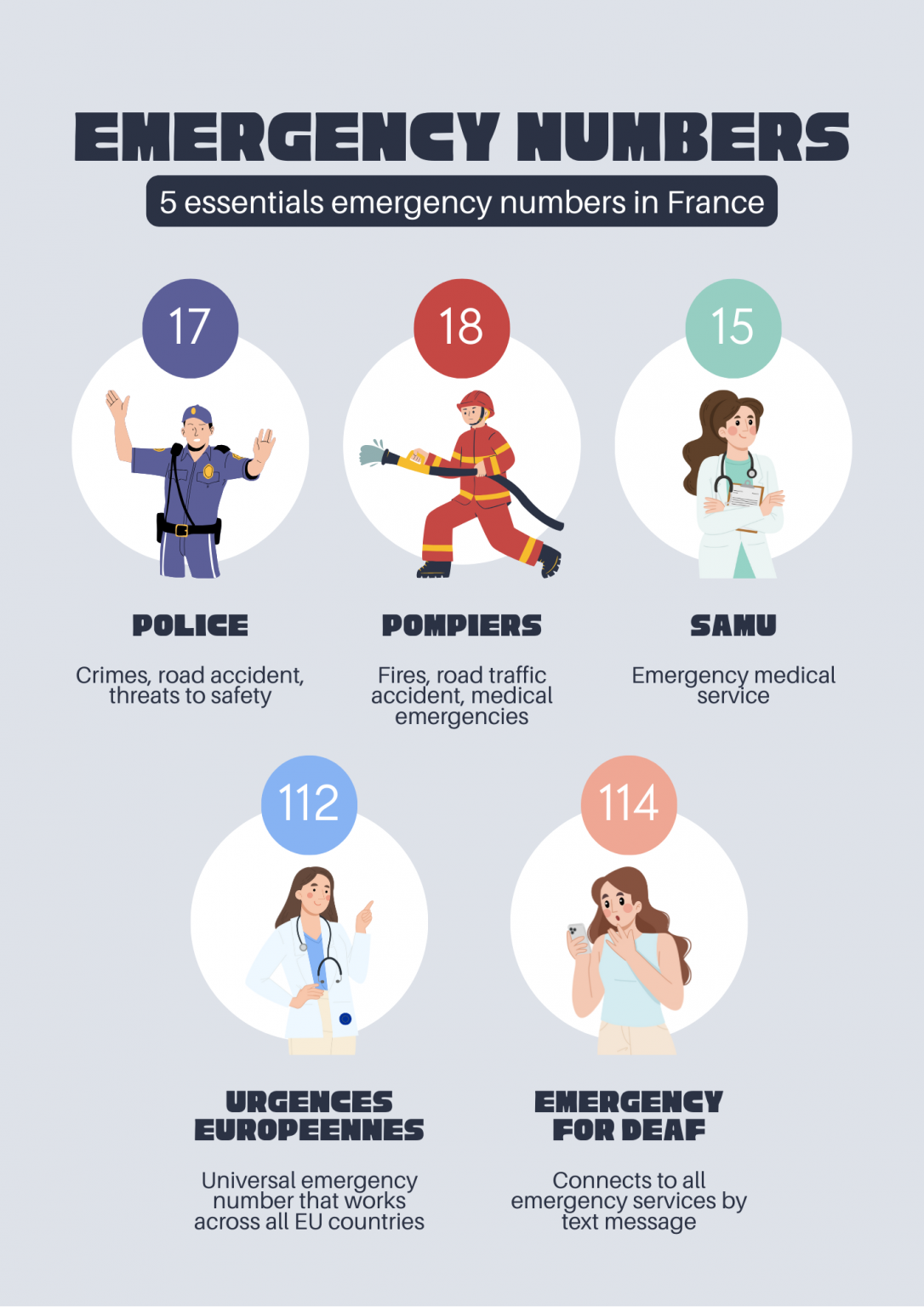
18 – Fire Brigade (Sapeurs-Pompiers)
The 18 is the emergency number for the French fire brigade, known as the sapeurs-pompiers. However, their role extends far beyond fighting fires. In France, firefighters are often the first responders to a wide range of emergencies.
When to call 18:
- Fires of any kind (building fires, forest fires, vehicle fires)
- Gas leaks or chemical hazards
- Road traffic accidents
- People trapped in lifts or buildings
- Medical emergencies (the fire brigade often arrives first)
- Natural disasters such as flooding
- Rescuing people or animals in danger
The French fire brigade is highly trained in emergency medical response, and in many rural areas, they may arrive before an ambulance. They work closely with other emergency services and can provide immediate life-saving assistance.
What to expect: When you call 18, be prepared to clearly state the nature of the emergency, the exact location (address, street name, landmarks), and any immediate dangers. The operator will dispatch the appropriate units and may give you instructions whilst help is on the way.
15 – Medical Emergency Services (SAMU)
Dialling 15 connects you to SAMU (Service d’Aide Médicale Urgente), France’s emergency medical service. This number is specifically for medical emergencies requiring urgent medical attention.
When to call 15:
- Heart attacks, strokes, or chest pain
- Severe injuries or trauma
- Difficulty breathing or choking
- Loss of consciousness
- Severe allergic reactions
- Poisoning
- Complications during pregnancy or childbirth
- Any life-threatening medical condition
When you call 15, you’ll speak to a trained medical regulator who will assess the situation and decide on the appropriate response. This might include dispatching an ambulance with paramedics, sending a mobile intensive care unit (SMUR), or providing medical advice over the phone.
Important note: SAMU coordinates emergency medical care and will work with other services like the fire brigade if needed. The medical regulator may ask detailed questions about symptoms, medical history, and current medications, so try to have this information ready if possible.
112 – European Emergency Number
The 112 is the universal emergency number that works across all European Union countries, including France. This number is particularly useful for tourists and visitors who may not remember the specific French emergency numbers.
When to call 112:
- Any emergency situation when you’re unsure which specific number to use
- Medical emergencies
- Fires
- Accidents
- Criminal incidents
- When travelling in France and facing an emergency
Calling 112 in France will connect you to an operator who can redirect your call to the appropriate emergency service (fire brigade, medical services, or police). The significant advantage of 112 is that operators are more likely to speak English and other languages, making it ideal for international visitors.
Accessibility benefit: The 112 number can be dialled even without a SIM card in your phone, as long as you have battery power and network coverage. This makes it invaluable in situations where your phone service might be limited.
17 – Police Emergency (Police Secours)
The 17 emergency number connects you directly to the French police (Police Secours or Gendarmerie Nationale, depending on your location).
When to call 17:
- Crimes in progress (theft, assault, break-ins)
- Road accidents (can also call 18)
- Reporting suspicious or dangerous behaviour
- Domestic violence situations
- Missing persons
- Threats to personal safety
- Witnessing any criminal activity
In urban areas, 17 typically connects to the Police Nationale, whilst in rural areas, it reaches the Gendarmerie Nationale. Both are law enforcement agencies, though they operate under different governmental structures.
What to communicate: When calling 17, provide clear details about the incident, including your location, description of any suspects, and whether anyone is in immediate danger. If it’s a crime in progress, stay safe and don’t put yourself at risk whilst waiting for police to arrive.
114 – Emergency Number for Deaf and Hard of Hearing
The 114 is a crucial emergency number specifically designed for people who are deaf, hard of hearing, or have speech difficulties. This service ensures that everyone has equal access to emergency services.
How 114 works:
- SMS text messaging service
- Fax communication
- Accessible 24/7 throughout France
- Connects to all emergency services
When to use 114: If you’re deaf, hard of hearing, or unable to speak due to a medical condition or dangerous situation, you can text 114 with your emergency. The service will relay your message to the appropriate emergency responders.
How to contact 114: Send an SMS to 114 including:
- The type of emergency (medical, fire, police)
- Your exact location
- A brief description of the situation
- Whether anyone is injured
The 114 service has trained operators who will coordinate the emergency response and may text back for additional information. This service is also useful in situations where making a phone call might put you in danger, such as during a home invasion.
Practical Tips for Calling Emergency Services in France
Language barriers
Whilst emergency operators in France primarily speak French, the 112 European emergency number often has access to multilingual operators. If you’re calling 15, 17, or 18 and don’t speak French, try using these simple phrases:
• “Do you speak English?” – Parlez-vous anglais ?
• “I need help” – J’ai besoin d’aide
• “Emergency” – Urgence
To make things easier in a stressful situation, you can also download our free PDF with the most useful French words and phrases to know in case of an emergency. Keep it on your phone so you can access it quickly when you need it.
Stay calm and speak slowly. Emergency operators are trained to handle calls from non-French speakers and will do their best to assist you.
Information to Provide
Regardless of which number you call, always be ready to provide:
- Your exact location: Street address, intersection, landmarks, or GPS coordinates
- Nature of the emergency: Medical, fire, accident, crime
- Number of people involved: Injured, trapped, or in danger
- Your contact number: In case they need to call you back
- Any immediate dangers: Fire spreading, aggressive individuals, ongoing medical crisis
Stay on the line
Don’t hang up until the operator tells you it’s okay to do so. They may need additional information or may provide you with life-saving instructions whilst help is on the way.
All Emergency Numbers Are Free
Every emergency number in France (18, 15, 112, 17, and 114) is completely free to call from any phone, including mobile phones, landlines, and payphones. You don’t need credit on your mobile to make an emergency call.
When You're Not Sure Which Number to Call
If you’re facing an emergency but aren’t certain which specific service you need, dial 112. The operator will assess your situation and connect you to the appropriate emergency service. It’s better to call and have your call redirected than to waste time trying to figure out the “right” number.
For non-urgent situations, such as reporting a crime after the fact or seeking medical advice that isn’t immediately life-threatening, there are alternative numbers to use rather than tying up emergency lines.
Special Considerations for Tourists and Expats
If you’re visiting or living in France, take a moment to save these emergency numbers in your phone before you need them. Programme them under clear names like “Emergency Fire” or “Emergency Medical” so you can find them quickly under stress.
Consider downloading translation apps or keeping a small card with key French phrases for emergencies. Many tourist information centres provide emergency contact cards in multiple languages.
If you’re travelling in remote areas, such as the Alps or rural countryside, be aware that emergency response times may be longer. Always inform someone of your plans and expected return time when hiking or engaging in outdoor activities.
Final Thoughts
Emergencies are stressful situations, but knowing which number to call in France can make all the difference. Whether it’s the fire brigade (18), medical emergency services (15), the universal European number (112), police (17), or the accessible service for those with hearing or speech difficulties (114), each plays a vital role in keeping people safe.
Take a few minutes to familiarise yourself with these numbers, save them in your phone, and share this information with family members, friends, or colleagues who might benefit from it. In an emergency, this knowledge could save precious time and potentially save lives.
Remember, emergency services in France are professional, well-trained, and ready to help. Don’t hesitate to call if you’re facing a genuine emergency – that’s precisely what these services are there for.
Stay safe, and we hope you never need to use these numbers, but if you do, you’ll now know exactly who to call.